
On holiday in Vasto, an itinerary between history and beaches
Vasto is a town worth visiting for its tourist attractions and its historical beauties. The city has a cultural heritage that rests on a long tradition of civilizations that have followed each other priceless leaving traces of their customs and traditions.
The city lies on a hill overhanging the sea, a coastline that you let go with pleasure, and along which stretches the beach Vasto Marina. Every summer, many tourists who flock to this part of the Adriatic coast. The Vasto sea is the main tourist attraction, He is having been awarded for several times with the title of European Blue Flag!
Another reminder is represented dall'Aqualand del Vasto, the largest water park in the Center-South of Italy. Definitely also visit the coast of Vasto, which it is the largest and most diverse in the region, and it is therefore one of the most appreciated by vacationers.
During the summer, from the port of Punta Penna direct maritime links to islands Tremiti.
To complete the identikit of an excellent tourist destination, excellent cuisine that makes use of precious and genuine products of the land devoted to agriculture, and beautiful scenery as well as architectural, Typical of a place that has a past and a very intense story.
What to see in and around Vasto: between past and present
At the more discerning visitor will not go unnoticed precious remains of augustee city, the traces of a medieval village. They survive the historical memory original architecture, such as portals S. Joseph S. Peter dating back to the thirteenth century; Castle Caldoresco, Towers Bassano, Diomede and the Moro Damante of the fifteenth century. To visit the Palazzo d'Avalos and the Church of Santa Maria Maggiore, as well as the Civic Museum, of the 1849, the oldest of the Region. Inland Vasto is the Temple Italico of Schiavi d'Abruzzo.
For those who like to go further and visit the city also, a few kilometers, in neighboring Molise you can visit the most important cultural complex of Sannio, which it is located in Pietrabbondante and Canneto, Abbey S. Maria del Canneto (X-XII sec.).
If you go north from SS. 16, you get the Benedictine Abbey of S. Giovanni in Venere, overlooking the Adriatic sea from a panoramic view.
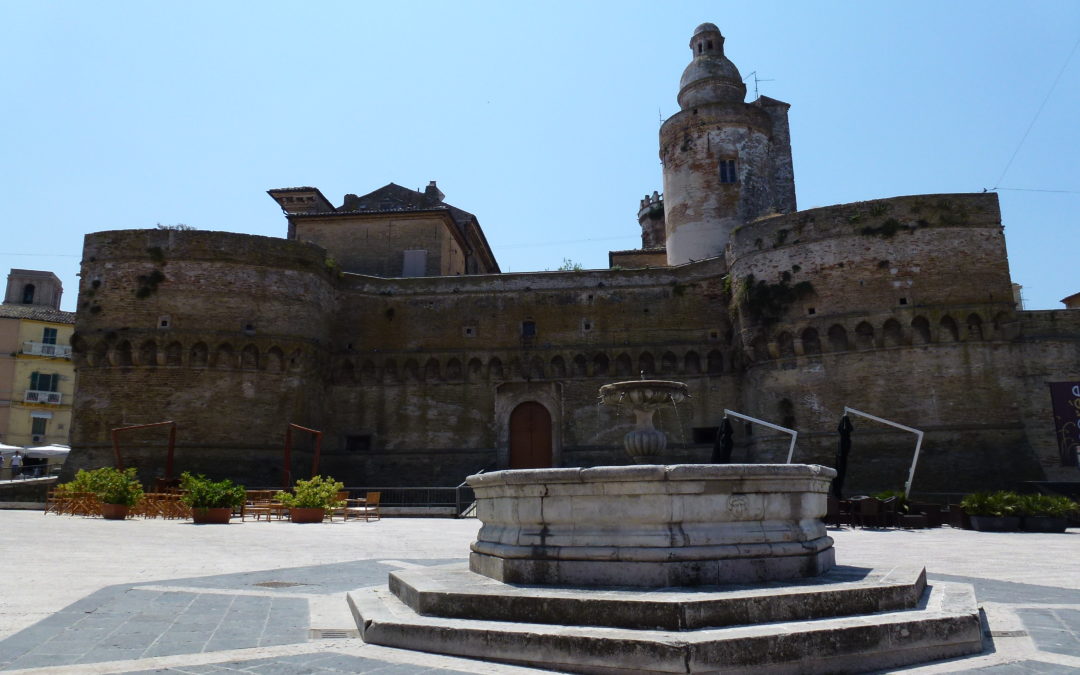
The Castle Caldoresco
Walking in the center of Vasto, please visit Castle Caldoresco (1439) which it was built by the Sienese Mariano di Jacopo behest of Giacomo Caldora, feaudatario and Lord of Vasto.
One of the most important monuments, The castle is located in the historical center of the city and turns his gaze on the square and Piazza Rossetti Barbacani, dominating the entire coast, and allowing you to enjoy a magnificent view of the waterfront.
The Caldoresco castle was born as a central hub of Vasto defensive structure and was built using the military precise techniques to limit a possible vulnerability of the walls.
At the center is a courtyard in medieval style, ramparts almond,
two towers and four curtain walls with a moat and drawbridge.
A Vasto there are many old churches, some of which should be cited for their importance: the Church of Santa Maria Maggiore, the Church of San Michele Arcangelo, St. Joseph's Cathedral, the Church of San Pietro.
The Palazzo d'Avalos and the Tower of Bassano
The Palace dates back to the D'Avalos 1427 and it was built by the feudal lord Giacomo Caldora on the plant of an existing structure 1300.
The noble family of Spanish origin Avalos came of a retelling when he moved his court in Vasto, volendone enrich the historical center.
Inside the palace you can visit the museums:
The Archaeological Museum, the oldest of Abruzzo with Iron Age relics to the Middle Ages.
Pinecoteca Civica, with paintings of the Palizzi
Museum of Costume Old, with costumes 800-900.
The tower dates back to Bassano 1439 and also at the behest of another noble, the Marquis de Bassano. The Tower is located in the historic center of Vasto, near the square Gabriel Rossetti.
This Hotel property, from the cylindrical shape and the entire brick, He was given the task of protecting the city, during the Middle Ages, when she was still present the walls, connected to the Castle Caldora.
The Regional Nature Reserve of Punta Aderci
An oasis of unspoilt natural beauty, which extends for 5 km from the beach Punta Penna south, to the mouth of Sinello river north, established in 1998. You can reach the reserve, located about 10 Km north of Vasto, along the highway.
The flora of the reserve is that of the Mediterranean. Here they grow spurge, the European searocket, weeds, sandstone ammofila, yellow poppy, sea lilies, myrtle, The sea holly, etc…
The plover bird, that lays eggs in the dunes area, It is the "mascot" of the Reserve. But in this natural paradise, those who enjoy bird watching, You can enjoy the passage of many species, from greater flamingo, al tarabusino, kestrels, la garzetta, the gray heron, squacco, night heron, le star, whitethroat, marsh harriers and cormorants.
Access to the reserve and the beaches is free!
The whole coast is in an uneven appearance, sometimes it consists of sand, time now cliffs of dunes and rock. A water deep blue, transparent seabed are the natural habitat of dolphins and sea turtles.
Within the Regional Natural Reserve of Punta Aderci there is the beach of Punta Penna, bordering the Port of Vasto. The beach looks pristine and wild, and is full of dunes that are the "home" ideal for several species of rare animals also.
Access to the beach via a wooden staircase.
South of the beach is the Lighthouse of Punta Penna (1906), that his 70 meters dominates the promontory near the port of Vasto. Right next to the lighthouse it is a small Romanesque church of the '400, Mary Pennaluce.
The most beautiful beaches of Vasto
Along the coast of the Reserve, right after the port of Vasto, continuing north, there is the beach of Punta Penna, The Libertini beach, the beach of Punta Aderci and beach Mottagrossa.
From the headland of Punta Aderci you can enjoy a wonderful view, between the beach and the sea, and in the background, majestic, Abruzzo mountains of Majella and Gran Sasso.
The Libertini beach is located between the Aderci headland and the beach of Punta Penna, and it is connected to the promontory by a small trail of steps.
In the northern part of the reserve is the beach Mottagrossa, the longest in the area, formed from pebbles, looking pristine and wild. At the side of the beach you can take a scenic trail that cuts, passing in the middle, The vegetation of the reserve.
From the historic center of Vasto, even better if the Palazzo d'Avalos, you can watch Vasto Marina beach, which it is located in a natural bay. This stretch of coast, characterized by a soft sand, by depths gradually descending, It is several kilometers long and its nature also lends itself well to families with children.
The kitchen Vasto
The Abruzzo cuisine of Vasto area is particularly affected by seafood specialties typical of the coastal regions.
Among the most common traditional meals which take place the typical pasta alla chitarra, sagne and beans (fasciul '), Perciatelli with squid ink, Pasta and potatoes, onion soup.
Among the second, instead, we find the kebabs, the famous fish soup, the mussels to Vastese, cient and where the pallotte,
Among the desserts there are many specialties: by cagionetti to cicerchiata, the typical chatter of Carnival period, the pepatelli, unwilling, the cooked must pizza, the neole, pizzelle, i bocconotti, parrozzo, the fiadoni, St. Joseph fried donuts.
Source: TurismoVasto